
New Year's Resolution for the USA: Learn more about vaccines
- Posted in:
- vaccines
- healthcare
- RFK
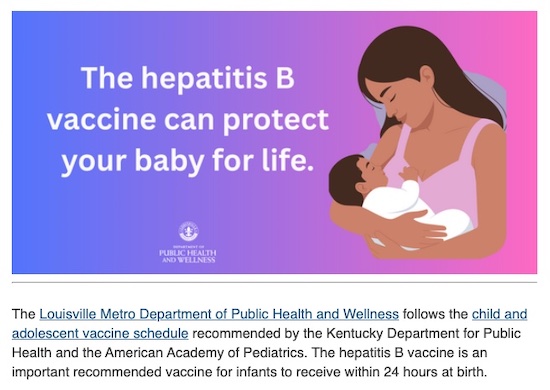
A recent e-news blast from the Louisville Metro Department of Public Health reminded parents or prospective ones to be sure their newborn gets the hepatitis B vaccine. (Screenshot from e-news)
However, in September, the Advisory Committee on Immunization Practices (ACIP) of the Center for Disease Control (CDC) determined that vaccination should be based on ‘individual-based-decision-making’ that in turn is based on whether the vaccine is known to be beneficial for those at increased risk of disease. They tabled a vote on whether to recommend delaying the first HepB vaccine until age 1 month.
Most recently, on December 5, 2025, the ACIP voted 8 to 3 , to end the long-standing universal recommendation for administering the hepatitis B vaccine to all newborns within 24 hours of birth. Under the new guidance, infants born to mothers who test negative for hepatitis B surface antigen are no longer automatically advised to receive the birth dose but to discuss the decision with their healthcare provider. For these infants, if vaccination is delayed, the first dose should be administered no earlier than 2 months of age. The recommendation remains unchanged for infants born to mothers who test positive for hepatitis B or whose status is unknown.
The ChildrensHealthDefense.org website addresses the rationale for the HepB vaccine for newborns:
But is it really “crucial” for all children to be so vaccinated? To highlight the rationality and importance of this question, consider the example of the CDC’s recommendation that all newborn babies receive a hepatitis B (HepB) vaccine, typically on their very first day of life. Many parents naturally wonder why it is considered so necessary to vaccinate their baby against a virus that is primarily transmitted sexually or through sharing of needles among injection drug users. The hepatitis B virus (HBV) can also be transmitted to infants at birth if the mother is a carrier, but screening to identify infected pregnant women is done routinely, and an alternative effective treatment has long been available for infants born to carriers. So is the HepB vaccine really necessary for all infants? Why does the CDC treat this vaccine as a one-size-fits-all solution when the vast majority of infants are not at significant risk of infection?
To answer this question, we need look no further than the CDC’s own stated rationale for this policy, which was adopted in 1991. Close examination of the CDC’s reasoning and the evolution of this policy illustrates that, far from being based on science, the decision by the CDC’s vaccine advisory committee to adopt this policy was faith-based and concerned primarily not with the health of infants, but with the agency’s overriding goal of achieving high vaccination rates. Comparing the policy with the science reveals that parents are right to be concerned because the policy unnecessarily puts children who are not at risk of infection at risk of harm from the vaccine.
Where to find information on vaccine dangers?
1. NIVC.org — The National Vaccine Information Center
- Learn about the risks and complications of infectious diseases and vaccines.
- See Selected NVIC Statements & Commentaries related to Hepatitis B or Hepatitis B Vaccine
- A ‘blast from the past’ - Hepatitis B Vaccine: The Untold Story
2. SoundChoice.org — Sound Choice Pharmaceutical Institute
- Website of Dr. Theresa Deisher, Ph.D., inventor on over 47 patents
- MISSION: End human trafficking and exploitation for the purposes of biomedical research and commercial products.
- Research showed that aborted fetal cells that contain residual DNA —when used in vaccines— can cause autism. Current vaccines in circulation which were manufactured using aborted fetal material include HepB. (This is disputed in some web searches.)
3. ChildrensHealthDefense.org — Litigation—Education—Science—Advocacy
- CHD was launched in response to growing concerns about the sharp rise in chronic health conditions among children.
- Unites parents, scientists, medical professionals, attorneys, and advocates to challenge the systems and policies that compromise public health.
- CHD shines a light on issues that are often overlooked or misrepresented
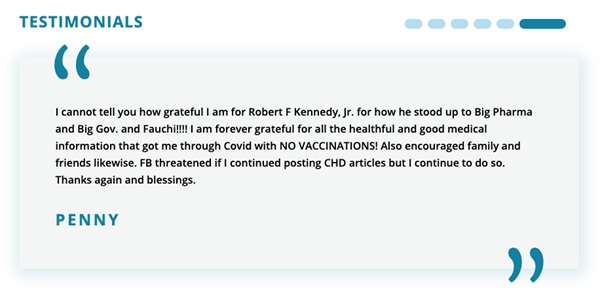
- A testimonial on the CHD website—
Learn what the current recommendations are
- Read here about Kentucky LAW on vaccines and immunization.
- CDC advice- NOT YET UPDATED.
- Cleveland Clinic
Troubling disclosure under oath
In a HighWire video on X.com, the world’s leading vaccine expert is asked during a deposition whether the Hep B vaccine was tested for only 5 days prior to its use on newborns. He states that this is true. Use of the HepB vaccine on newborns has resulted in neurological damage, hypersensitivity syndrome, autoimmune disease, and more. The deficient clinical trials are the basis for the long-term recommendation for newborns to be immunized for Hep B.
ASIDE:
Robert F. Kennedy, currently Secretary of the Department of Health and Human Services (HHS), has come under intense attacks from the American Medical Assoc., American Academy of Pediatrics, America College of Physicians, and American Public Health Assoc., for his efforts to replace the members of the CDC Advisory Committee on Immunization Practices and to reform the vaccine industry. He was appointed by President Trump to Make America Healthy Again. The growth of Autism Spectrum Disorder from 2 in 10,000 children in 1960 to the 2022 incidence of 1 in 31 is cause for alarm. This is only one in many examples of red flags in American healthcare.
His leadership was recently questioned by Democratic Representative Haley Stevens of Michigan who filed articles of impeachment against him on December 10, 2025. So far no vote has occurred and her action is not likely to advance to a Senate trial. Nineteen states and the District of Columbia are suing RFK and HHS for plans to prevent government payments for transgender treatments.
Kennedy has long been involved in vaccine research and helping parents whose children have been harmed by mandated immunizations. Mothers whose children had become autistic after vaccinations sought him out because of his track record as an attorney who understood mercury poisoning from his environmental legal work. Mercury has been a component of vaccines as a preservative. The ChildrensHealthDefense.org website was founded by RFK, who co-founded its predecessor, the World Mercury Project.
The American Academy of Pediatrics (AAP) has been cited by RFK for its role in insisting on vaccinations for newborns and others. See this article.
A Kentucky legislature bill that became law in 2025 included the AAP and other pro-choice medical associations' endorsements to lend credibility. This was hard to understand considering that KY is considered to be a pro-life state. In an article on LPM.org there is a reference to AAPLOG, the pro-life association for Ob/Gyns, that may offer some explanation on this.
The Epoch Times News reported on January 1, 2026, that RFK has stopped mandating health care providers report the immunization status of patients. Change is ongoing, so stay tuned to this topic!