
Same-sex marriage hot potato
- Posted in:
- Kim Davis
- Supreme Court
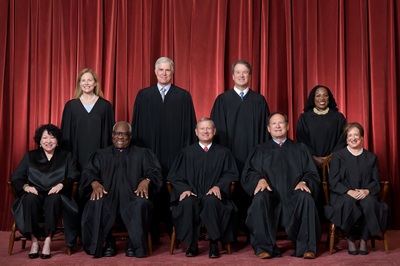
SCOTUS Justices 2025
The purpose of this article is to post links and excerpts from online resources relating to the Kim Davis Supreme Court Petition to overturn the same-sex marriage ruling, ‘Obergefell v. Hodges’. Kim also requested a review of a federal appeals court ruling that upheld an award of $100,000 that she must pay to a gay couple who sued her for denying them a marriage license.
Both requests were denied on November 10. The SCOTUS blog stated:
As is generally the case when it denies petitions for review, the court did not provide any explanation for its decision not to hear Davis’ case. If any justices disagreed with the decision not to take up the case, they did not note that disagreement publicly.
The screenshot of the November 10, 2025, SCOTUS Order List is ‘to the point’.

Some may wish to explore this topic, and be next in line to file an appeal. It took MANY appeals and MANY accompanying amicus briefs before SCOTUS overturned Roe v. Wade based on Dobbs v. Jackson.
The Liberty Counsel defense team website provided background on the case:
Believing marriage as a union between one man and one woman, Davis ceased issuing any marriage licenses from June 29 to early September 2015 while she sought an accommodation for her religious beliefs. But two sets of plaintiffs, including David Ermold and David Moore, sought to mock Davis’ Christian faith by forcing her name on their marriage license through litigation. Their attempt failed when Gov. Steven Beshear agreed that the altered license without Davis’ name was valid. From early September onward, licenses were issued without Davis’ name on them. In December 2015, newly elected Governor Matt Bevin issued an executive order granting the accommodation Davis sought. Then in April 2016, the Kentucky legislature unanimously codified the religious exemption by removing the names of all clerks from the state’s marriage licenses.
Prior to this, however, the courts used Obergefell to deny her a religious accommodation that unconstitutionally forced her to choose between her religious beliefs and her livelihood. Ermold and Moore could have gone to any number of nearby clerks to get a marriage license. But they wanted Davis’ name on their license. In 2017, Ermold and Moore amended their complaint and sued Davis in her individual capacity for emotional distress for “hurt feelings.” In addition to six days in jail, Davis was held liable for $360,000 in damages and attorney’s fees over their “hurt feelings” stemming from her religious expression…
Liberty Counsel Founder and Chairman Mat Staver said, “Davis was jailed, hauled before a jury, and now faces crippling monetary damages based on nothing more than purported hurt feelings. By denying this petition, the High Court has let stand a decision to strip a government defendant of their immunity and any personal First Amendment defense for their religious expression.
On the Foundation for Moral Law (FML) website we see there were many Amici for this appeal.
More background is provided by FML
The Foundation presents Alabama’s unique experience as a case study in the turmoil caused by Obergefell. Despite an overwhelming state constitutional amendment (81% in favor) defining marriage as between one man and one woman, Alabama officials were forced into a constitutional crisis—caught between conflicting commands from the U.S. Supreme Court and their own state constitution. When Alabama Chief Justice Roy Moore insisted that probate judges continue to follow Alabama law until properly superseded, he was removed from office. This, the brief argues, demonstrates the chaos and coercion produced when federal judges usurp powers reserved to the people and their states.
Before Obergefell, marriage was understood as a matter for the states—recognized even in United States v. Windsor (2013). Two years later, however, Justice Kennedy reversed course, imposing a nationwide mandate for same-sex marriage. The Foundation argues this abrupt reversal trampled the rights of more than thirty states that had enacted laws affirming traditional marriage and destabilized the constitutional balance between federal and state authority. (KY was one of these states - Ed)
The brief also warns that Obergefell set the stage for widespread persecution of Americans who hold biblical beliefs about marriage. The imprisonment of Kim Davis, the forced resignations of county clerks, and the legal battles of Jack Phillips (Masterpiece Cakeshop) and Catholic Social Services (Fulton v. City of Philadelphia) illustrate the weak gesture the Court made toward religious freedom. The Foundation asserts that freedom of religion is not merely the right to believe or teach, but to live and act according to one’s faith—rights that Obergefell has eroded.
Drawing on the writings of Jefferson, Joseph Story, and Madison, the brief emphasizes that rights of conscience come from God, not the State. The judiciary has no authority to compel citizens to violate those rights or to redefine the divine institution of marriage, which Scripture defines as the union of one man and one woman (Genesis 2:18–24; Matthew 19:6).
Using Abraham Lincoln’s famous illustration—‘calling a tail a leg doesn’t make it a leg’—the Foundation argues that redefining marriage by judicial decree does not alter reality or divine law. Marriage, as established by God, predates the state and forms the foundation of family and civilization. To claim judicial authority over this sacred institution, the brief asserts, is to claim authority over God Himself.
The Claremont Institute’s Center for Constitutional Jurisprudence and the National Organization for Marriage submitted an Amicus brief. Read it here.
Excerpt:
As the Petition points out, the dispute here was not about whether Respondents were entitled, under Obergefell, to obtain a marriage license. They could have obtained one in a number of ways, and in fact did. The dispute is whether they could compel the issuance of a marriage license by a particular county clerk whose sincerely-held religious faith precluded her from issuing such a license in her own name. That kind of “bend the knee” demand is not permissible in our society. See, e.g., W. Virginia State Bd. of Educ. v. Barnette, 319 U.S. 624, 638 (1943). Certiorari is therefore warranted to, at the very least, ensure that religious faith is protected in its exercise, not just in its advocacy.
Fastzone's articles on this case include a website post and a two-part article on the Fastzone.substack blog.